How the Alteryx One Insights MCP Server helps organisations accelerate enterprise AI while maintaining governance, security and compliance
Every financial institution wants to put AI in the hands of its analysts. Far fewer have solved one critical question: how do you allow AI to access business insights without exposing sensitive data or weakening governance?
It is one of the biggest barriers to enterprise AI adoption. Banks and insurers have invested heavily in governed analytics platforms, but connecting large language models to those environments has often meant choosing between innovation and control. Organisations either lock AI out of the data estate entirely or open doors that are difficult to close. Neither option is acceptable for firms operating in highly regulated environments.
Earlier this year, as part of Alteryx's partner preview programme, our team had the opportunity to test something that changes that equation: the Alteryx One Insights MCP Server. What we found was genuinely worth sharing.
Why AI integrations create governance challenges
Across financial services, AI initiatives are rapidly moving beyond copilots and proof of concepts. Organisations now want AI to interrogate operational data, answer business questions and accelerate decision-making. However, regulators increasingly expect explainability, auditability and robust data controls. The challenge is no longer whether AI works – it is whether it can be trusted inside governed environments.
The instinct in many organisations is to connect AI tools directly to data sources – databases, data lakes and warehouses – and allow models to query freely. In consumer applications, that may be acceptable. In financial services, it rarely is.
Raw data exposure creates compliance risk. Uncontrolled AI queries create audit gaps. When something goes wrong – whether a model hallucinates a figure or sensitive information appears in a response – organisations need clear governance, traceability and accountability.
The Alteryx One Insights MCP Server takes a fundamentally different approach. Rather than connecting AI to raw data, it connects AI to governed, pre-calculated analytics outputs – the same outputs already produced by Alteryx Auto Insights. The underlying data never leaves the environment. Instead, AI receives computed measures, trends, correlations and business summaries while the raw records remain securely where they belong.
For Chief Data Officers, Heads of Analytics and compliance teams, that distinction is significant.
How the Alteryx One Insights MCP Server works
Model Context Protocol (MCP) is emerging as one of the key standards for connecting AI assistants with enterprise systems. Rather than building bespoke integrations for every application, MCP provides a common interface that allows AI models to securely interact with approved tools and services.
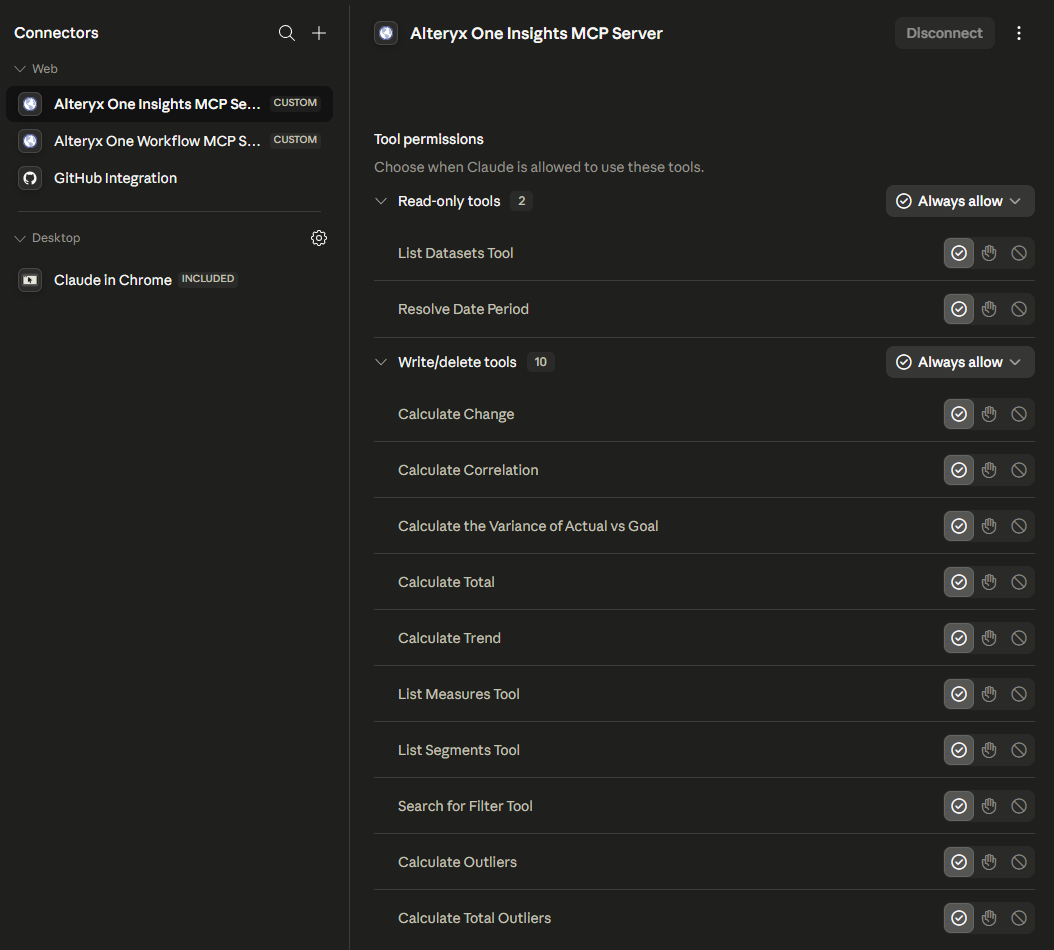
The Alteryx One Insights MCP Server exposes a suite of analytical tools that AI assistants – including Claude, Microsoft Copilot and other leading providers – can invoke through MCP. These tools perform the analytical tasks teams carry out every day, including calculating totals, identifying trends, measuring variance, detecting anomalies and comparing performance across business segments.
Importantly, these are not experimental capabilities developed solely for this integration. They are the same production-tested analytical services that already power Alteryx Auto Insights, giving organisations confidence that they are building on proven, enterprise-grade analytics rather than introducing untested technology.
Authentication is managed through OAuth 2.0, allowing organisations to integrate the MCP Server into existing identity and access management frameworks without creating bespoke security models or bypassing established controls.
The configuration overhead is equally impressive. Connecting an AI assistant to the MCP Server requires no new data engineering pipeline, no additional ETL development and no changes to underlying data sources. For organisations already using Alteryx One, the route to AI-assisted analytics is significantly shorter than many alternative approaches.
In practice, this means analysts can ask natural-language questions about governed analytics – identifying unusual trends, comparing business performance or generating executive-ready summaries – without ever requiring direct database access.
Real-world financial services use cases
During the preview programme, we explored two scenarios that reflect the types of analytical challenges many financial services organisations face today.
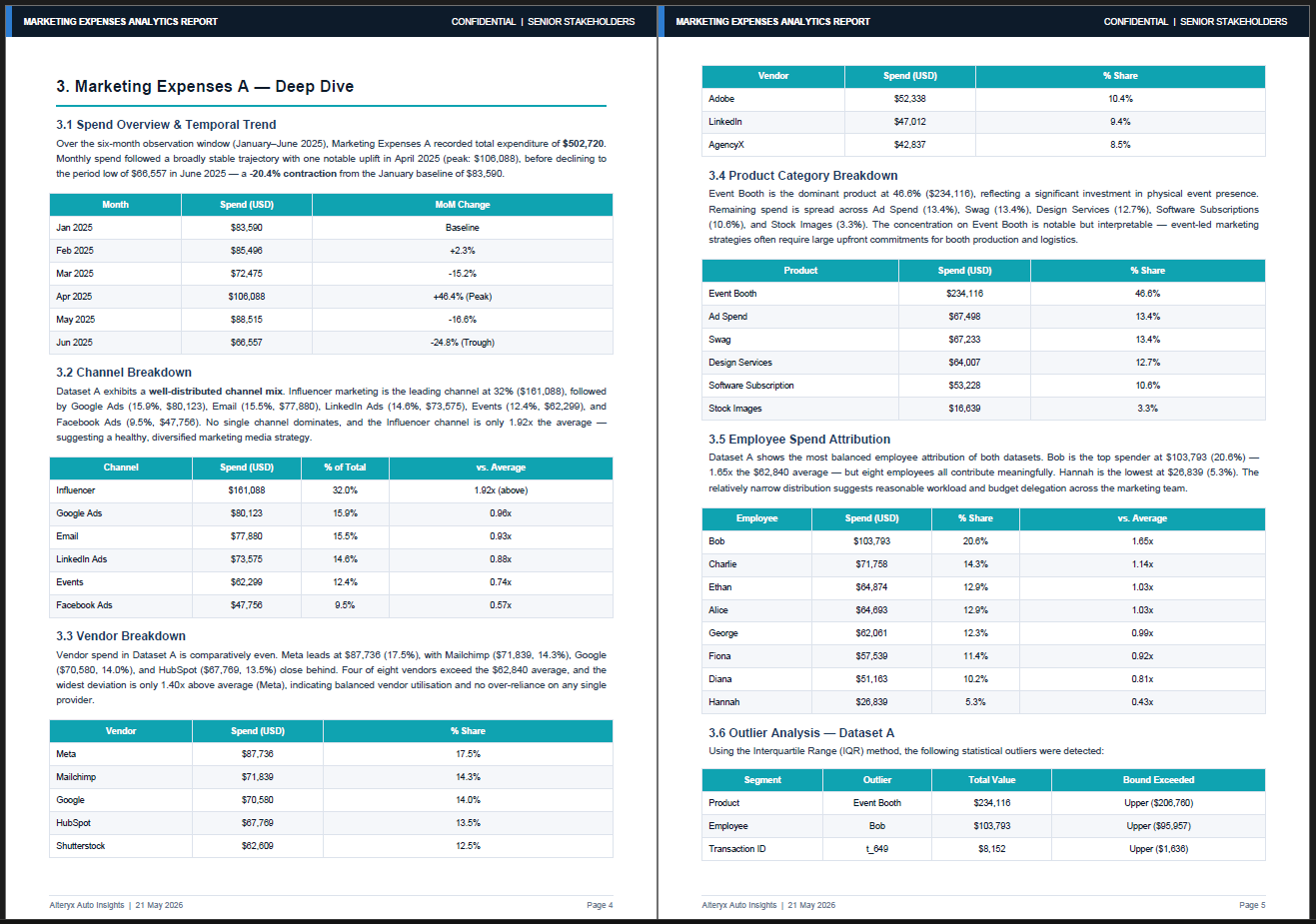
In the first scenario, AI produced a comparative marketing expenditure report, analysing spend by channel, vendor, product category and employee across a six-month period. The solution identified outliers, calculated month-on-month variance and generated a structured, publication-ready report in minutes, using only governed Alteryx Insights data with no raw data exposure.
The second scenario demonstrated even greater value from a governance and risk perspective.
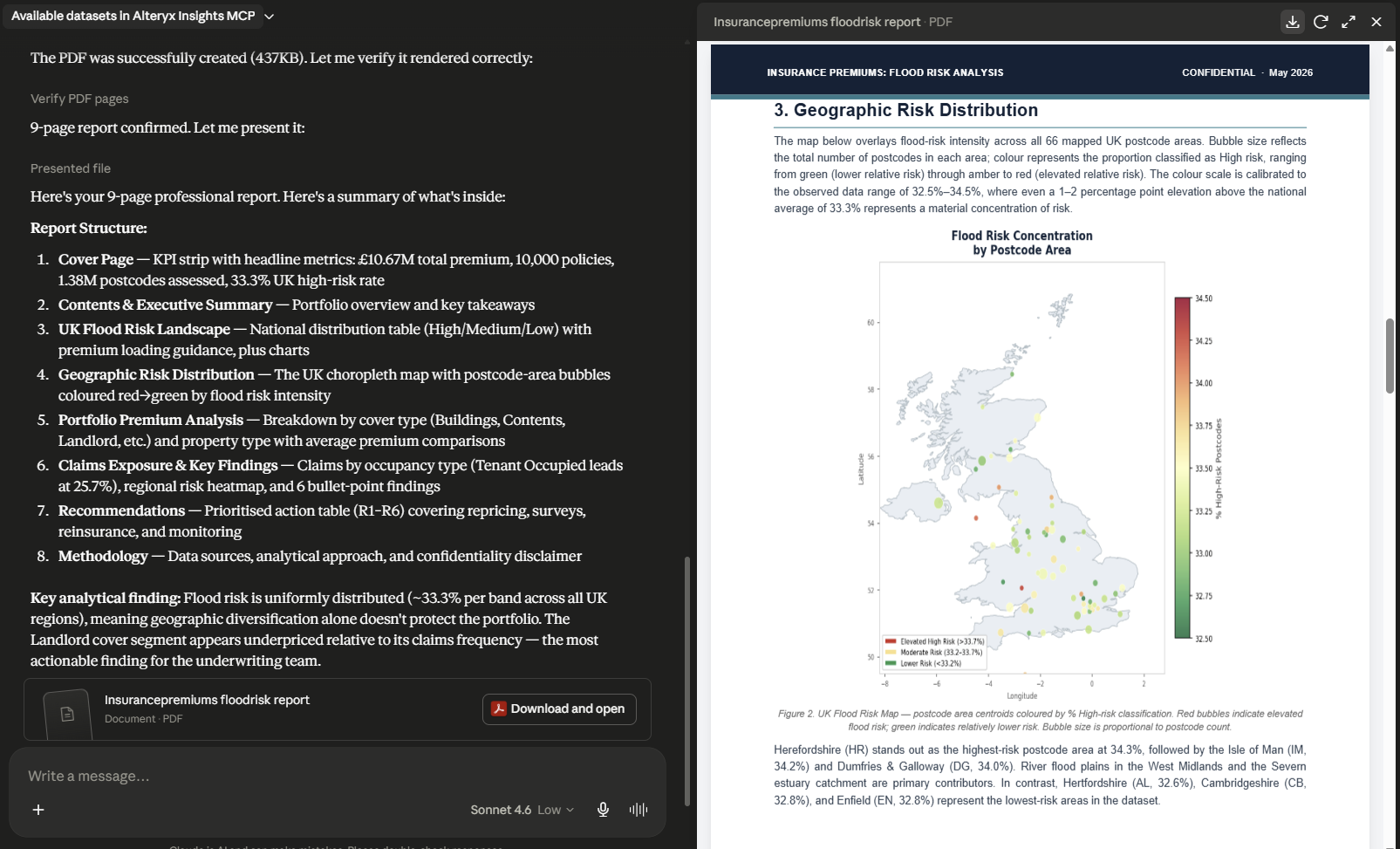
Using insurance premium and flood-risk analysis across 66 UK postcode areas – representing more than 1.3 million postcode records – the AI generated a comprehensive nine-page report covering geographic risk distribution, portfolio premium analysis by cover type and prioritised recommendations for underwriting teams.
Work that would traditionally require analysts several days to source, prepare, analyse and present was completed in minutes. Geographic risk segmentation, landlord underpricing indicators and claims exposure analysis were all generated using governed Alteryx Insights outputs rather than direct database queries.
These are not technology demonstrations for the sake of innovation. They represent the type of analytical work that exists across almost every financial services organisation today – work that consumes highly skilled analyst time and often delays business decision-making.
Why governed AI matters for enterprise adoption
One of the biggest barriers to enterprise AI adoption is not capability. Most organisations already recognise the potential of AI to transform analytics and decision-making.
The real challenge is governance.
Boards, regulators and risk functions rightly expect AI to be explainable, auditable and secure. Data lineage must be preserved, access must be controlled and organisations need confidence that outputs can be trusted.
The Alteryx One Insights MCP Server addresses these challenges through its architecture rather than treating governance as an afterthought. Because AI never accesses raw data directly, data lineage remains intact. Authentication through OAuth 2.0 ensures secure, auditable access. Because the analytical capabilities are already validated in production through Alteryx Auto Insights, organisations benefit from trusted, consistent outputs rather than introducing new analytical logic.
Unlike traditional business intelligence dashboards, AI assistants also enable users to interrogate governed analytics conversationally. Rather than relying on predefined reports, business users can explore data dynamically, ask follow-up questions and generate narrative insights while remaining within approved governance frameworks.
For organisations looking to move beyond isolated AI pilots towards sustainable enterprise AI, this type of architecture represents the difference between experimentation and operational capability.
Final thoughts
The question for most financial services organisations is no longer whether to integrate AI into their analytics landscape. The question is how to do so in a way that stands up to scrutiny from regulators, governance committees and internal risk functions.
The Alteryx One Insights MCP Server is one of the most practical examples we have seen of how enterprise AI can be introduced without compromising governance. It extends AI's capabilities without widening the attack surface. It accelerates insight generation while preserving the controls that make those insights trustworthy.
At NextWave, we help financial services organisations bridge the gap between AI ambition and enterprise delivery. From AI strategy and governed analytics to automation, data platforms and regulatory-ready AI solutions, we work with clients to design and implement architectures that are secure, scalable and built for long-term adoption.
If your organisation is exploring how to connect AI with governed analytics while maintaining trust, compliance and control, get in touch with the NextWave team to discuss how we can help you move from AI pilots to enterprise-scale transformation.
